



© 2025 Creatingbig Publishing (OPC) Private Limited.All rights reserved
“Shadows Across the Levant”
A Global Spy Thriller

Chapter One — Langley, Virginia
Rows of monitors bathed the CIA analysis bay in blue light, broken only by the feverish tapping of Maya Kerrigan’s fingers. The gentle hum of machines was a thin comfort. She needed familiar noise. Noise meant everything was still under her control.
She let her eyes unfocus for a second, gazing at the data flows not as information, but as melody: metrics, times, ports, weights, all swirling like music only she could hear.
Why am I still doing this? she wondered. Because someone has to see the pattern in the cold, humanless noise. Because if I don’t, another Istanbul happens. Or Kabul happens again – but this time to someone else’s family.
Her phone buzzed with a message from Facilities. She ignored it, mind leaping ahead.A sharp-click stride echoed—Director Alan Rourke, always looming out of the shadows like an unwelcome conscience. He’d been her boss long enough to sense her moods, though he pretended otherwise. The smell of his aftershave signaled command, or at least the attempt to feign it.
He barely waited for hello. “Talk to me, Kerrigan. Give me the story, not the symptoms.”
His tone jabbed at Maya’s fatigue, but she drew a steady breath, fingers tightening on her coffee mug.
She spoke, pitching her voice low and certain. “Check the blue line on this manifest—Odessa to Istanbul. Now compare the weight logs. It’s up three percent mid-shipment despite a signed customs seal. I traced the discrepancies to the shipping schedules in Singapore. Five containers with red-flag quantum tech signatures turned up registered as oil drums. All vanish for a six-hour window, then turn up on manifests from a different security contractor.”
Rourke’s features barely shifted, but his attention grew sharp as a blade.
He’s calculating the odds, Maya thought. How much power I’ll have if I’m right, how alone I’ll be if I’m wrong. How much blame he’ll have to shoulder either way.
He asked, “How deep do you think this goes?”
“Deeper than any single agency,” she said. She didn’t allow herself to show fear. “We’re talking someone with muscle, influence, and the kind of technical know-how you get from rogue nation-states on payroll.”
He took off his glasses and pinched the bridge of his nose, sighing.
In that pause, Maya’s thoughts raced. What if I’m wrong? I never wanted to be one of the cold ones, the analysts without empathy. But what if they actually are safer that way—less blood on their hands, less loss when the calls go south.
He finally muttered, “That’s twice in two months, Kerrigan. You’ve made enemies with every department head except Cyber. Keep this off the main grid—brief only London and Berlin. If you’re lying, it’s my reputation buried with yours. If you’re right… God help us all.”
He hesitated in the doorway. “We don’t chase ghosts, Maya. Find me a body.”
She watched him go, chin set with stubborn pride and a churn of anxiety in her gut. She was brilliant, but she was young, and she burned with the fear of being overlooked at exactly the wrong moment.
......& the thrill continues....
Coming soon
Top
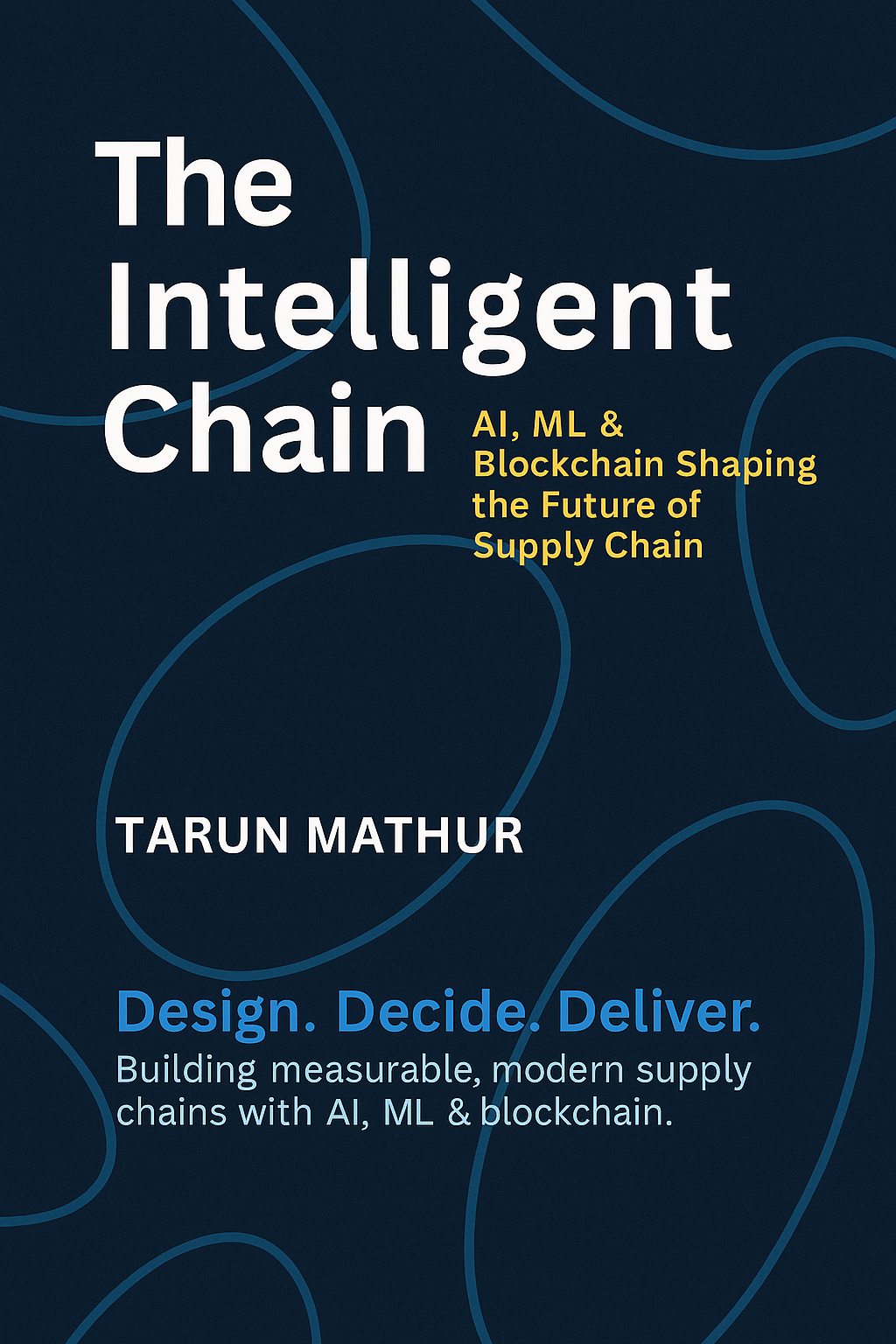
“The Intelligent Chain”
AI, ML & Blockchain Shaping the Future of Supply Chain
Supply chains are social systems powered by technology. Over three decades of leading operations at the apex level in a multinational conglomerate, I have learned that the breakthroughs that endure are not the flashiest algorithms but the ones that respect how people make decisions under pressure, how data really flows across partners, and how risk, cost, service, and sustainability must be balanced every day. I wrote this book to turn that lived complexity into a usable playbook—one you can apply on Monday morning and still be proud of five years from now.
This volume progresses from foundations to execution. We begin by clarifying what makes a supply chain “intelligent”: stable identities and data contracts, continuous sensing, calibrated digital twins, explainable AI/ML, and guardrailed automation that proves what it did and why. We then examine the enabling technologies—AI and machine learning for forecasting and allocation, blockchain for provenance and selective disclosure, IoT for real-time visibility, robotics for safe and repeatable work, and cloud data fabrics for scale—and show how they converge into closed loops that learn. Midway, the focus shifts to the operating model: talent, governance, cybersecurity, and responsible AI. Later chapters tackle sustainability and circularity as operational disciplines, not afterthoughts, and explore the road ahead to 2030–2040 through scenarios and a staged capability roadmap. We end with a practical conclusion that ties outcomes (service, cost, and carbon) to controllable levers and the evidence needed to sustain trust.
This book is intentionally opinionated. It argues for data contracts and identity before dashboards; for calibrated digital twins before autonomy; and for “proofs over payloads” when collaborating across partners. It also assumes that modernization succeeds only with disciplined governance—model review, privacy and data councils, change control—and with a culture that values explanation as much as prediction.
I am grateful to the many operators, planners, engineers, drivers, warehouse associates, and partners who have taught me what works when the plan meets reality. Their wisdom is embedded here—in the insistence on explainability, in the bias toward short feedback loops, and in the respect for the craft at every node of the chain.
If this book helps you ship more reliably, spend more wisely, and tread more lightly—while strengthening trust with customers and partners—then it will have done its job. The table of contents is clickable to help you navigate; the figures are designed for direct reuse in your programs. Above all, treat this as a working manual. Mark it up. Test the ideas. Keep what proves out. Improve the rest. That is how intelligent supply chains—and the teams behind them—get better.
Buy Now
Top